ROLE
Product Design Intern
Duration
February - April.2023
TEAM
WFDN - Transportation
Rental Marketplace Platform

Project Description
Our team focuses on designing global internal platforms and products related to the process of the transportation, storage, fulfillment, and delivery of customer orders.
PO Visibility
Wayfair’s Transportation Specialists, EMTs, and Warehouse Supervisors use the PO Visibility feature in 4Sight to track and investigate customer orders.
Impact
Our team introduced a PO Visibility Search History feature to help users revisit previously searched orders and improve the search experience. This feature was part of the Stage 3 launch of 4Sight in Q2.
How might we make Search History useful?
Problems
Users wanted a search history feature in PO Visibility, but it was unclear what information would best help them recall past orders.
Users struggle to remember past searches. Which data points in search history would best help them recognize and return to a previous search?
Goals
Define key data points
Identify the most relevant information (e.g., search term, date, product status) to include in search history.
Revisit past searches easily
Design a simple, intuitive way for users to revisit or reuse past searches.
Solution
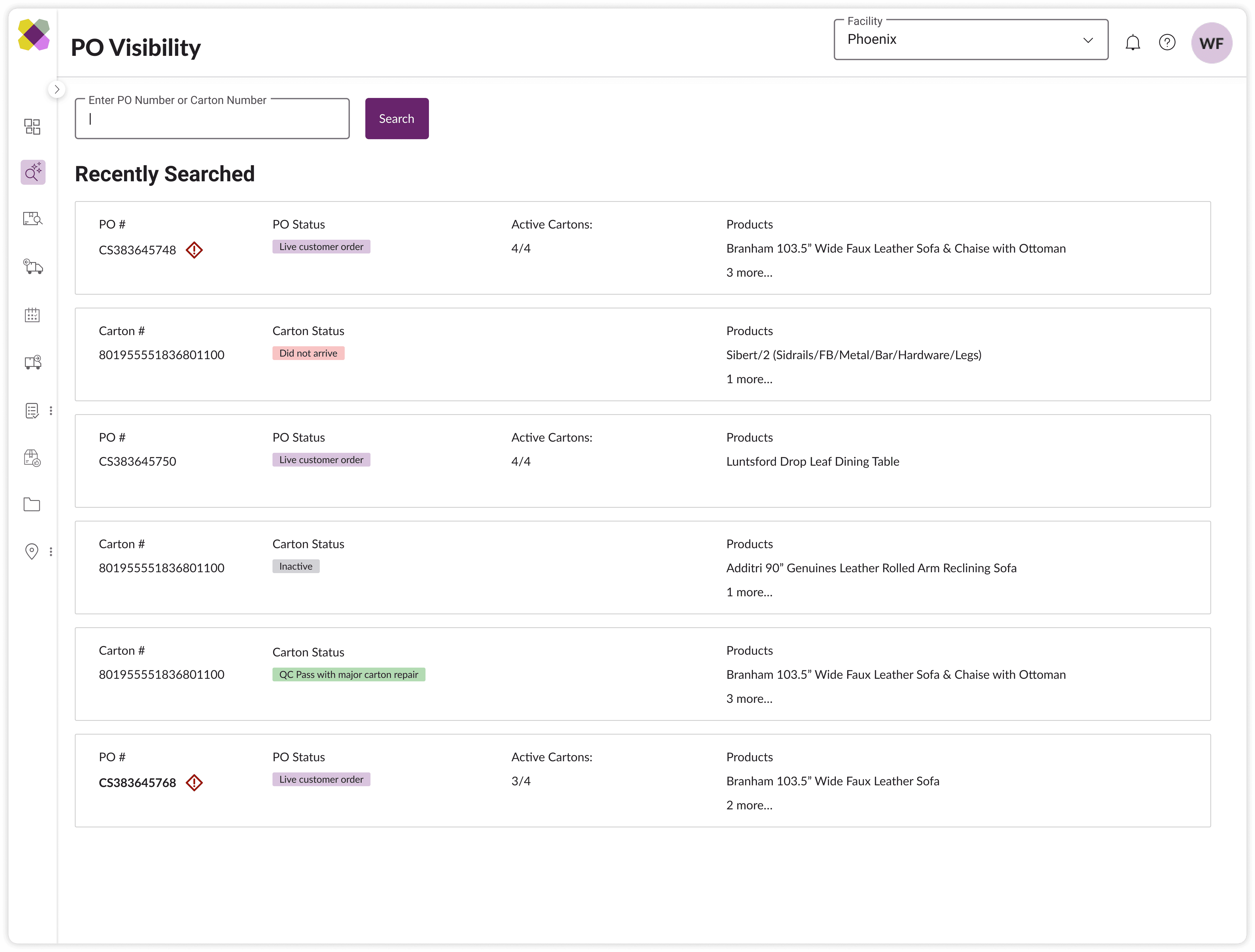
Provide a clean and structured Search History on the PO Visibility landing page in 4Sight, displaying key information that allows users to quickly return to recently searched product orders.
Research: How User Interviews Informed Feature Requirements
Discovery & Define
To address the project challenges, I focused on understanding users’ needs around search history and identifying the data points that would help them quickly return to previous searches.
I conducted 1:1 interviews with Transportation Specialists, Supervisors, EMTs, and Warehouse Supervisors to learn what information they value most in a search history interface.

User interviews revealed key expectations for PO Visibility search history. Based on these insights, I prioritized the necessary data points and aligned with the product manager and my mentor to finalize the feature requirements.

Ideation & Design: Exploring Ways to Present Search History
Although the entire website required a redesign, the first priority was to create MVP user flows and a Sitemap to establish the information architecture and define the basic framework of the platform.
Ideation
Based on the research insights, I developed a set of design solutions focused on prioritizing key data points and improving the usability of search history.


Initial Design
Design Challenge
While search history dropdowns are typically minimal, our case required supporting richer data with a more structured and scannable layout.
Solutions

Feedback: Incorporating Input from Users, Team, and Developers
Feedback
I often ask, “Why is this design better than the alternative?” This question guides the rationale for the final solution, which is refined through multiple iterations and feedback.
Through design critiques and user feedback, I gained valuable insights that improved the design and strengthened my understanding of user needs while tackling new design challenges.
“We're familiar with carton numbers and their associated information, and we want to focus exclusively on carton information in the carton-level historical record.”
Defining Primary and Fallback Order Identifiers
Based on feedback that users rely on carton-level information to identify orders, I plan to prioritize it and use PO-level information as a fallback to improve clarity and reduce visual noise.
Exploring Alternatives for Ambiguous Status Icons
Improving Space Efficiency in Search History Design

Iteration: Replacing the Dropdown with a Card-Based Layout
Based on user feedback, I refined information hierarchy, reduced visual clutter, and improved clarity by aligning the UI more closely with user mental models.
Design Challenge
How might we reduce the visual noise of the dropdown on the PO Detail page?
How might we balance design quality with implementation feasibility during iterations?
Design Solution
Based on an audit of other internal products, I replaced the dropdown with a card-based layout on the landing page, enabling users to view each search history item clearly and reducing visual clutter.

After

Before
Inspirations from Other Internal Products - Exceptions
I drew inspiration from internal products using card-based layouts and applied it to the landing page to display search history clearly.
How does it work?

What I’ve done to improve?
Order history was moved to the PO Visibility landing page, allowing users to review recent searches at a glance while reducing clutter on the product detail page.
How does it work?

Final Design
After iterating on the design, I received positive feedback from the users, design team and engineering team, confirming a successful handoff. It was exciting to see the search history feature in PO Visibility go live before the end of my internship 🎉.


Reflection
🤔 User-centered design for diverse use cases
While dropdowns are standard for search history, our internal platform required more detailed information. Moving beyond the traditional approach allowed us to design a more efficient solution.
👨💻 Trade-off Designs under Technological Constraints
Effective design balances usability with technical feasibility, creating solutions that are both easy for users and efficient to implement.
PO Visibility Search History
PO Visibility Search History
PO Visibility Search History
ROLE
Product Design Intern
TEAM
WFDN - Transportation
duration
February - April.2023
ROLE
Product Design Intern
TEAM
WFDN - Transportation
duration
February - April.2023
Project Description
Project Description
Our team focuses on designing global internal platforms and products related to the process of the transportation, storage, fulfillment, and delivery of customer orders.
Our team focuses on designing global internal platforms and products related to the process of the transportation, storage, fulfillment, and delivery of customer orders.
PO Visibility
PO Visibility
Wayfair’s Transportation Specialists, EMTs, and Warehouse Supervisors use the PO Visibility feature in 4Sight to track and investigate customer orders.
Wayfair’s Transportation Specialists, EMTs, and Warehouse Supervisors use the PO Visibility feature in 4Sight to track and investigate customer orders.
Impact
Impact
Our team introduced a PO Visibility Search History feature to help users revisit previously searched orders and improve the search experience. This feature was part of the Stage 3 launch of 4Sight in Q2.
Our team introduced a PO Visibility Search History feature to help users revisit previously searched orders and improve the search experience. This feature was part of the Stage 3 launch of 4Sight in Q2.
How might we make Search History useful?
How might we make Search History useful?
Problems
Problems
Users wanted a search history feature in PO Visibility, but it was unclear what information would best help them recall past orders.
Users struggle to remember past searches. Which data points in search history would best help them recognize and return to a previous search?
Users wanted a search history feature in PO Visibility, but it was unclear what information would best help them recall past orders.
Users struggle to remember past searches. Which data points in search history would best help them recognize and return to a previous search?
Goals
Goals
Define key data points
Identify the most relevant information (e.g., search term, date, product status) to include in search history.
Revisit past searches easily
Design a simple, intuitive way for users to revisit or reuse past searches.
Define key data points
Identify the most relevant information (e.g., search term, date, product status) to include in search history.
Revisit past searches easily
Design a simple, intuitive way for users to revisit or reuse past searches.
Solution
Solution
Provide a clean and structured Search History on the PO Visibility landing page in 4Sight, displaying key information that allows users to quickly return to recently searched product orders.
Provide a clean and structured Search History on the PO Visibility landing page in 4Sight, displaying key information that allows users to quickly return to recently searched product orders.
Research: How User Interviews Informed Feature Requirements
Research: How User Interviews Informed Feature Requirements
Discovery & Define
Discovery & Define
To address the project challenges, I focused on understanding users’ needs around search history and identifying the data points that would help them quickly return to previous searches.
I conducted 1:1 interviews with Transportation Specialists, Supervisors, EMTs, and Warehouse Supervisors to learn what information they value most in a search history interface.
To address the project challenges, I focused on understanding users’ needs around search history and identifying the data points that would help them quickly return to previous searches.
I conducted 1:1 interviews with Transportation Specialists, Supervisors, EMTs, and Warehouse Supervisors to learn what information they value most in a search history interface.
User interviews revealed key expectations for PO Visibility search history. Based on these insights, I prioritized the necessary data points and aligned with the product manager and my mentor to finalize the feature requirements.
User interviews revealed key expectations for PO Visibility search history. Based on these insights, I prioritized the necessary data points and aligned with the product manager and my mentor to finalize the feature requirements.
Ideation & Design: Exploring Ways to Present Search History
Ideation & Design: Exploring Ways to Present Search History
Although the entire website required a redesign, the first priority was to create MVP user flows and a Sitemap to establish the information architecture and define the basic framework of the platform.
Although the entire website required a redesign, the first priority was to create MVP user flows and a Sitemap to establish the information architecture and define the basic framework of the platform.
Ideation
Based on the research insights, I developed a set of design solutions focused on prioritizing key data points and improving the usability of search history.
Based on the research insights, I developed a set of design solutions focused on prioritizing key data points and improving the usability of search history.
Initial Design
Initial Design
Design Challenge
While search history dropdowns are typically minimal, our case required supporting richer data with a more structured and scannable layout.
Solutions
Design Challenge
While search history dropdowns are typically minimal, our case required supporting richer data with a more structured and scannable layout.
Solutions
Design Challenge
While search history dropdowns are typically minimal, our case required supporting richer data with a more structured and scannable layout.
Solutions
Feedback: Refining the Experience Through Cross-Functional Feedback
Feedback: Refining the Experience Through Cross-Functional Feedback
Feedback
Feedback
I often ask, “Why is this design better than the alternative?” This question guides the rationale for the final solution, which is refined through multiple iterations and feedback.
Through design critiques and user feedback, I gained valuable insights that improved the design and strengthened my understanding of user needs while tackling new design challenges.
I often ask, “Why is this design better than the alternative?” This question guides the rationale for the final solution, which is refined through multiple iterations and feedback.
Through design critiques and user feedback, I gained valuable insights that improved the design and strengthened my understanding of user needs while tackling new design challenges.
“We're familiar with carton numbers and their associated information, and we want to focus exclusively on carton information in the carton-level historical record.”
“We're familiar with carton numbers and their associated information, and we want to focus exclusively on carton information in the carton-level historical record.”
Defining Primary and Fallback Order Identifiers
Based on feedback that users rely on carton-level information to identify orders, I plan to prioritize it and use PO-level information as a fallback to improve clarity and reduce visual noise.
Exploring Alternatives for Ambiguous Status Icons
Improving Space Efficiency in Search History Design
Defining Primary and Fallback Order Identifiers
Based on feedback that users rely on carton-level information to identify orders, I plan to prioritize it and use PO-level information as a fallback to improve clarity and reduce visual noise.
Exploring Alternatives for Ambiguous Status Icons
Improving Space Efficiency in Search History Design
Defining Primary and Fallback Order Identifiers
Based on feedback that users rely on carton-level information to identify orders, I plan to prioritize it and use PO-level information as a fallback to improve clarity and reduce visual noise.
Exploring Alternatives for Ambiguous Status Icons
Improving Space Efficiency in Search History Design
Iteration: Replacing the Dropdown with a Card-Based Layout
Iteration: Replacing the Dropdown with a Card-Based Layout
Based on user feedback, I refined information hierarchy, reduced visual clutter, and improved clarity by aligning the UI more closely with user mental models.
Based on user feedback, I refined information hierarchy, reduced visual clutter, and improved clarity by aligning the UI more closely with user mental models.
Design Challenge
Design Challenge
How might we reduce the visual noise of the dropdown on the PO Detail page?
How might we balance design quality with implementation feasibility during iterations?
How might we reduce the visual noise of the dropdown on the PO Detail page?
How might we balance design quality with implementation feasibility during iterations?
Design Solution
Design Solution
Based on an audit of other internal products, I replaced the dropdown with a card-based layout on the landing page, enabling users to view each search history item clearly and reducing visual clutter.
Based on an audit of other internal products, I replaced the dropdown with a card-based layout on the landing page, enabling users to view each search history item clearly and reducing visual clutter.
Before
Before
After
After
Inspirations from Other Internal Products - Exceptions
I drew inspiration from internal products using card-based layouts and applied it to the landing page to display search history clearly.
How does it work?
Inspirations from Other Internal Products - Exceptions
I drew inspiration from internal products using card-based layouts and applied it to the landing page to display search history clearly.
How does it work?
Inspirations from Other Internal Products - Exceptions
I drew inspiration from internal products using card-based layouts and applied it to the landing page to display search history clearly.
How does it work?
What I’ve done to improve?
Order history was moved to the PO Visibility landing page, allowing users to review recent searches at a glance while reducing clutter on the product detail page.
How does it work?
What I’ve done to improve?
Order history was moved to the PO Visibility landing page, allowing users to review recent searches at a glance while reducing clutter on the product detail page.
How does it work?
What I’ve done to improve?
Order history was moved to the PO Visibility landing page, allowing users to review recent searches at a glance while reducing clutter on the product detail page.
How does it work?
Final Design
Final Design
After iterating on the design, I received positive feedback from the users, design team and engineering team, confirming a successful handoff. It was exciting to see the search history feature in PO Visibility go live before the end of my internship 🎉.
After iterating on the design, I received positive feedback from the users, design team and engineering team, confirming a successful handoff. It was exciting to see the search history feature in PO Visibility go live before the end of my internship 🎉.
Reflection
Reflection
🤔 User-centered design for diverse use cases
While dropdowns are standard for search history, our internal platform required more detailed information. Moving beyond the traditional approach allowed us to design a more efficient solution.
👨💻 Trade-off Designs under Technological Constraints
Effective design balances usability with technical feasibility, creating solutions that are both easy for users and efficient to implement.
🤔 User-centered design for diverse use cases
While dropdowns are standard for search history, our internal platform required more detailed information. Moving beyond the traditional approach allowed us to design a more efficient solution.
👨💻 Trade-off Designs under Technological Constraints
Effective design balances usability with technical feasibility, creating solutions that are both easy for users and efficient to implement.